





BLOG
Can the system detect driver fatigue before a microsleep happens?
The Invisible Danger of Fatigue
Driver fatigue is one of the most dangerous conditions on British roads—and one of the most difficult to manage through conventional fleet oversight. Unlike speeding or harsh braking, which generate data that can be reviewed after a journey, fatigue is invisible until it produces an incident. A driver who falls asleep at the wheel on a motorway at 70mph has no warning to give a supervisor, no signal that can be picked up by GPS tracking, and no fault code that CANbus can report. By the time fatigue causes a collision, the opportunity for intervention has already passed.The Fatal Reality of Fatigue
The scale of the problem is significant. Fatigue is estimated to contribute to approximately one in five road accidents in the United Kingdom, and to two in five fatal crashes on motorways and dual carriageways. The commercial vehicle sector carries disproportionate exposure. Professional drivers regularly work long hours, drive at night or in the early hours, and operate under scheduling pressures that can work against adequate rest. Whether it is an HGV driver covering 400 miles on an overnight run, a waste collection driver starting at 4am, or a multi-drop courier managing seventeen stops on a summer afternoon, all are operating in conditions where the consequences of a microsleep event are catastrophic.AI-Driven Physiological Monitoring
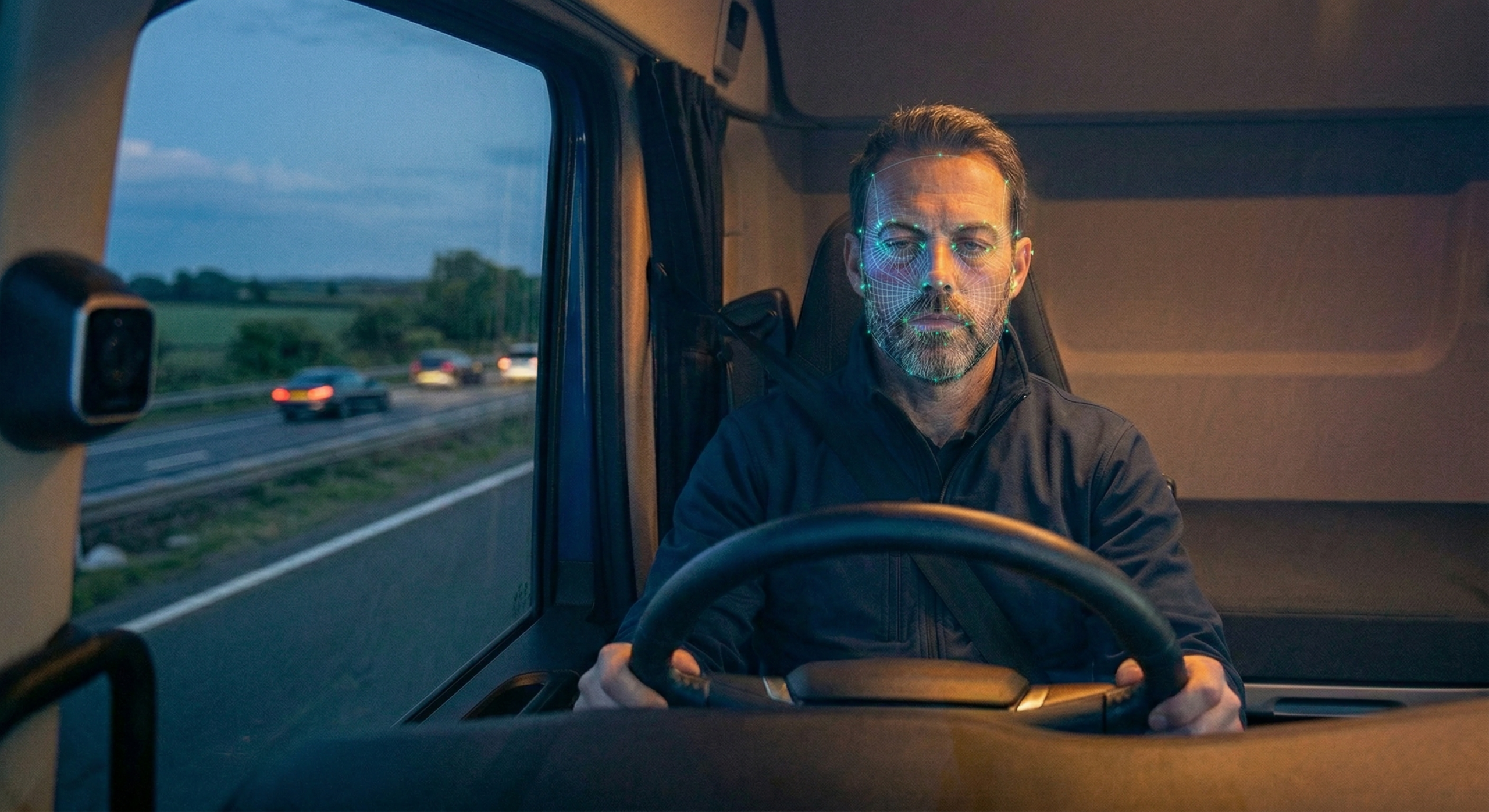
Fleet Focus has developed a fatigue detection system that addresses this challenge at the physiological level, before a microsleep occurs. The system uses sophisticated face and eye-tracking algorithms embedded in AI cameras to continuously monitor the driver’s face throughout every journey. Rather than waiting for the gross motor failure of a head-drop or a lane departure—by which point a microsleep may already be under way—the Fleet Focus system detects the precursors. It identifies the progressive slowing of blink rates, the subtle elongation of eye closure duration, and the micro-expressions of drowsiness.How the System Detects Fatigue Early
This distinction between detecting the approach of fatigue and detecting its consequences is a critical technical achievement. The system monitors eye closure patterns in real time, measuring the ratio of eyes-open to eyes-closed time against individual baseline data for that driver. It also tracks head position and movement, detecting the nodding or tilting that accompanies the onset of drowsiness. Furthermore, it monitors yawning frequency and changes in facial muscle tone that correlate with declining cognitive alertness. All of this analysis happens continuously, frame by frame, across every minute of every journey, without requiring any manual input from the driver.Immediate, Unmissable Interventions
When the system identifies a pattern consistent with emerging fatigue, it does not simply log the event for later review. It intervenes immediately through a combination of audio alerts—a loud, attention-grabbing sound designed to break through drowsiness—and visual alerts on the in-cab display. Where hardware is fitted, the system can also trigger vibration through the seat or steering wheel. The intervention is designed to be impossible to ignore, ensuring that even a driver whose brain is not fully conscious is alerted before a total loss of control.Proactive Results and Behavioural Change
The effectiveness of this intervention is documented in the Fleet Focus operational data. Following an initial fatigue alert, over 90% of vehicles show no repeat fatigue event for the remainder of that journey. This is not simply because the driver has been startled awake; it is because the alert triggers a conscious response. Drivers may stop at the next services, open a window, or make a call—actions that address the underlying condition. The system does not just detect fatigue; it catalyses the behavioural response that reduces it.Leveraging Face Match and GPS for Total Visibility
For fleet managers, every fatigue event is captured and uploaded to a central platform with video evidence, timestamps, GPS locations, and driver identification via Face Match. This creates an operational record that supports both individual driver coaching and wider scheduling analysis. If a particular driver consistently triggers fatigue alerts on early-morning runs, it highlights a scheduling and welfare issue that needs to be addressed at the roster level, rather than being managed driver by driver.Duty of Care and Legal Protection
The legal and duty-of-care implications of this capability are significant. An operator who can demonstrate they deployed active fatigue monitoring is in a fundamentally stronger position than one who relied on self-reporting or paper-based records. In the event of a serious incident, the difference between demonstrated active management and the absence of it can determine the outcome of an official investigation.Conclusion: A Professional Obligation
For construction fleets, waste and recycling operators, and logistics companies, fatigue detection is no longer an optional upgrade—it is a professional obligation. Fleet Focus makes it practical, affordable, and immediately deployable. Contact Fleet Focus on 0800 009 3006 or request a call back to discuss fatigue monitoring for your fleet.The Bottom Line
Fatigue cannot be managed through policy alone; it requires technology that detects the physiological reality before a driver loses consciousness. Fleet Focus provides a system that intervenes in the seconds before a microsleep, not in the aftermath of a collision. For any fleet running vehicles in early mornings, overnight, or on long motorway routes, fatigue detection is a core duty-of-care obligation.References
- Department for Transport – Reported Road Casualties in Great Britain: Annual Report. Available at: www.gov.uk/government/statistics/reported-road-casualties-great-britain-annual-report-2024/reported-road-casualties-great-britain-annual-report-2024
- Royal Society for the Prevention of Accidents (RoSPA) – Fatigue and Road Safety. Available at: www.rospa.com/health-and-safety-news/driver-fatigue-and-road-collisions
- DVSA – The Official Highway Code: Rule 91 — Tiredness. Available at: www.highwaycodeuk.co.uk/rules-for-drivers-and-motorcyclists-fitness-to-drive.html
- Horne, J. & Reyner, L. (1999). Vehicle accidents related to sleep: a review. Occupational and Environmental Medicine, 56(5), 289–294.
- Fleet Focus – our platform: Fatigue Detection Operational Data, 2024.
Book Your Free Trial
Take control of trailers, tools and equipment with Fleet Focus BLE tracking. Simple to install, low cost, fully integrated, and built for real fleets.